June 24, 2026
Complete Guide To Arriving In Canada As An International Student: What To Expect At The Border — Interviews, Documents & Your Rights
by Hareesh Babu C. S.
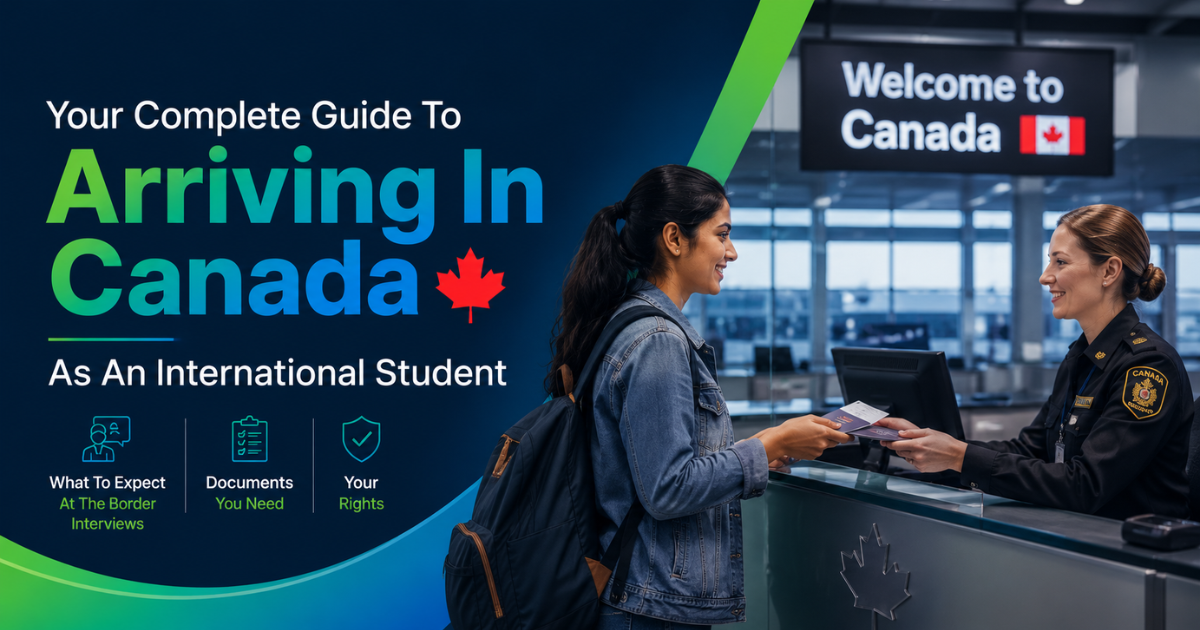
Complete Guide To Arriving In Canada As An International Student: What To Expect At The Border — Interviews, Documents & Your Rights
The moment your plane lands in Canada, your study journey officially begins. But before you can step foot into your dorm room or attend your first lecture, you have to pass one important checkpoint: the Canada Border Services Agency (CBSA) inspection. This may be scary to many students. At MWT we believe knowledge is the best travelling companion. This guide will take you through every step of the process, from the documents you need to carry to the exact questions border officers will ask and how to answer them with confidence.
Part 1: Understanding the Border Inspection Process
Every traveller arriving in Canada goes through border inspection citizens, residents, and international students alike. As an incoming student, the officer is not simply doing a routine check. They are verifying that you meet Canada's entry requirements, and specifically that you have what immigration law terms 'temporary resident intent' meaning you understand your study permit is time-limited and you intend to comply with its conditions.
Two Stages: Primary and Secondary Inspection
Your border entry happens in up to two stages:
Primary Inspection
This is the first checkpoint every traveller passes through. An officer will review your documents, ask a few questions and decide whether to admit you, refer you elsewhere or send you to secondary inspection. This stage is typically brief.
Secondary Inspection
Being referred to secondary inspection does not mean you are in trouble. The CBSA describes it as a normal and routine part of the process. It simply means the officer needs more time — to verify documents, ask follow-up questions, or inspect your belongings. Expect the process to take longer, and be prepared to answer the same questions again.
MWT Tip: Remain calm if you are sent to secondary. This is common for students and is not a warning sign. “Most important is to be cooperative and consistent in your answers.”
Part 2: What You Must Declare at the Border
Canadian law places a responsibility on every traveller to declare certain things when entering the country. As a student, you are expected to know and comply with these requirements. Most importantly, if you are carrying CAD $10,000 or more in cash or monetary instruments including foreign currency, bank drafts, bearer bonds or traveller's cheques you must declare this to the border officer. You can bring as much as you like, but if you do not declare any amount of $10,000 or more it is a legal offence and money can be seized on the spot.
MWT Tip: Always count your cash and monetary instruments before you travel. If in doubt, declare. Declaring is never penalised not declaring can be.
Part 3: The Documents You Must Carry — In Your Hand Luggage
This is probably the most important part of your preparation. Your important documents should be in your carry-on luggage, not stashed away in checked baggage. If your bag is delayed or lost, you may be without proof of your authorization to study.
The following are the core documents you must present:
Essential Documents (Every Student)
- Port of Entry (POE) Letter of Introduction issued when your study permit was approved. A printed copy is ideal, but an electronic version is acceptable.
- Valid Letter of Acceptance from your school
- Valid passport (with your visitor visa or eTA stamp inside, if required for your nationality)
- Any additional documents specifically requested by the visa office when your permit was approved
Additional Documents (Many 2026 Students)
Depending on your specific circumstances, you may also need:
- Provincial Attestation Letter (PAL) or Quebec Acceptance Certificate (CAQ), if your program requires one
- Proof of funds — bank statements, GIC confirmation letters, or scholarship documentation
- Tuition payment receipts
- Medical examination confirmation, if you completed one as part of your application
- Housing information and Canadian emergency contact details
MWT Tip: Organise your documents in a clear plastic folder in a fixed order before you leave home. When the officer asks for your POE letter or proof of funds, you should be able to produce it immediately not be seen fumbling through a bag. First impressions at the border matter.
Part 4: The Border Interview — What Officers Will Ask You
The interview is where many students feel nervous, but it should not be provided you have prepared. Officers ask questions across four key categories. Here is what to expect in each one, and how to approach your answers.
Category 1 — Identity and Travel Purpose
The officer will first find out who you are and why you are coming into Canada. They’re easy questions, but they set the mood for the whole interaction. Your answers must align exactly with your study permit application.
Typical questions include:
- What is the purpose of your visit to Canada?
- How long do you plan to stay?
- Where will you be living in Canada?
Critical Warning: Never say you are coming to Canada 'to immigrate' or 'to find a job' when entering on a study permit. These responses directly contradict your permit application and can result in refusal at the border.
Category 2 — Your Studies
This is the most detailed category, and where inconsistencies are most likely to raise concerns. Officers verify your answers against the information already in your application file. Be prepared to speak confidently and specifically about your studies.
Typical questions include:
- What programme are you enrolled in?
- Which institution are you attending, and where is it located?
- When does your programme start, and how long does it run?
- Why did you choose this specific school and programme?
- What did you study previously, and how does this programme connect to your prior education or future career?
MWT Tip: Know your institution’s full official name, your programme’s full title, your start date and your programme length before you travel. Read your school’s website so you can speak naturally about what the course covers. Vague or unsure answers are a red flag.
Category 3 — Finances
Officers must be convinced that you can support yourself financially during your studies without working illegally. Be prepared to talk about your finances and your work authorization status in a clear manner.
Typical questions include:
- Who is funding your studies — parents, a sponsor, a scholarship?
- How much money are you bringing into Canada?
- Do you have any employment lined up?
Regarding employment: international students with a valid study permit are generally able to work up to 24 hours a week off-campus during academic terms, once they have started their programme and meet the eligibility criteria. If you intend to work part-time be honest about it and make it clear that you understand and will adhere to the restrictions that apply to your permit.
MWT Tip: Bring printed out bank statements and your GIC confirmation letter. Even if the officer doesn’t ask for them, having them out shows you’re prepared and willing to be transparent.
Category 4 — Ties to Home and Post-Graduation Intent
This is the most nuanced category, and one that catches even well-prepared students off guard. Officers are assessing what is called temporary resident intent your genuine understanding that your study permit is temporary, and your commitment to complying with its conditions.
Typical questions include:
- Do you have close family in Canada?
- Do you plan to stay in Canada after graduation?
- What do you intend to do after you finish your studies?
Canadian immigration law recognises something called dual intent the fact that a person can have genuine temporary resident intent (as a student) while also being open to pursuing permanent residence in the future. This is perfectly legal and acceptable. The idea is to realize that your current position is temporary and tentative.
For example, saying “I plan to apply for the Post-Graduation Work Permit (PGWP) and gain Canadian work experience, and maybe look at permanent residence options afterwards” is in line with dual intent and should not cause alarm. What officers cannot accept is a response suggesting you have no intention of leaving Canada at the end of your authorised stay.
MWT Tip: Never lie about your future intentions. If you are considering the PGWP or permanent residency, you are permitted to say so. What you must demonstrate is that you currently understand your study permit is temporary and that you will abide by its conditions.
Part 5: Why Honesty Is Non-Negotiable
Under Canadian immigration law specifically Section 40 of the Immigration and Refugee Protection Act misrepresentation carries severe consequences. A foreign national found inadmissible for misrepresentation remains inadmissible for a period of five years. This would not only end your Canadian study journey, but could affect future immigration applications to Canada and potentially to other countries.
Critically, the legal threshold is lower than most people assume. Misrepresentation does not have to be deliberate. Giving wrong information by mistake or withholding a material fact even inadvertently may amount to a misrepresentation under the Act.
The safest approach, always, is to tell the truth. If you did not understand a question, ask the officer to repeat it. If you need an interpreter, request one you are entitled to this. And if you are unsure how to answer a particular question, say so honestly rather than guessing.
MWT Tip: At MWT, we prepare every student for their border interview before departure. This is not about scripting answers it is about helping you understand what officers are actually asking, so you can answer naturally, confidently, and honestly.
Part 6: After the Interview — Check Your Study Permit
If the officer is satisfied with your documentation and answers, they will issue you your physical study permit document at the counter. Before you walk away, take a moment to check three things carefully:
- Your full name and date of birth — confirm these match exactly what appears in your passport or travel document
- The permit expiry date — verify that this is correct
- Work authorisation — if you are eligible to work off-campus, check that this condition is clearly printed on the permit.
If you notice any error or discrepancy no matter how small raise it with the officer immediately, before you leave the counter. Corrections made at the point of issuance are far simpler than attempting to amend a permit after the fact. Do not assume errors will sort themselves out.
MWT Tip: Take a photograph of your study permit as soon as you receive it. Store it securely in a cloud folder along with scanned copies of all your key documents. If you ever lose your permit or it is stolen, you will need a copy to obtain a replacement quickly.
How MWT Prepares You
At MWT Education Consultancy, we have guided hundreds of students through every stage of their Canada study journey from choosing the right programme and preparing a strong application, to arriving at the border confident, prepared, and ready to succeed.
Our pre-departure sessions cover everything in this guide in detail, with personalised mock interview practice, document review, and a complete arrival checklist tailored to your specific permit conditions and institution.
If you have questions about your upcoming arrival, your study permit conditions, or anything else covered here, reach out to your MWT advisor directly. We are here every step of the way.
Author: Hareesh Babu

Written by
Hareesh Babu C. S.
ENQUIRE NOW
September 22, 2026
Study in Australia in 2026–2027
Australia has confirmed a National Planning Level of 295,000 new overseas student commencements for 2027, maintaining the same level as 2026. The announcement reinforces Australia’s continued commitment to international education while managing student growth through a structured system.
September 11, 2026
Why Clinical Communication is a Core Nursing Skill in Australia
Explore why clinical communication is essential in Australian nursing and how it supports patient safety, clinical care, teamwork, and effective communication in healthcare settings.
June 24, 2026
Complete Guide To Arriving In Canada As An International Student
This guide helps international students prepare for their arrival in Canada by explaining the CBSA inspection process, required documents, common border questions, and how to answer them confidently.
June 22, 2026
Understanding the AHPRA Self-Check
Building a nursing career abroad offers opportunities for growth, international exposure, and professional development. Australia is a popular choice due to its regulated healthcare system and high professional standards, attracting many internationally qualified nurses seeking to practise as Registered Nurses (RNs).
June 18, 2026
Why Eligible Nurses Still Miss Opportunities
Meeting Australia’s nursing eligibility requirements is a major achievement, but it does not guarantee immediate progress. Learn why the registration journey often pauses here and what you can do to keep your plans moving forward.
May 26, 2026
Nurses Stepping into International Nursing
Becoming an internationally registered nurse is a major achievement, but succeeding within a global healthcare system requires far more than clinical ability alone. This blog explores how communication, workplace etiquette, adaptability, teamwork, and professional conduct shape the reputation of international nurses working abroad.
April 30, 2026
Is Your GNM Qualification Enough for a Nursing Career in Australia
Struggling to understand why your GNM qualification does not meet Australian nursing registration standards? Find out why this qualification gap exists and how the GCAN program provides the exact bridge to your Australian career.
April 30, 2026
AHPRA’s Revised English Test Scores for 2026
With AHPRA’s 2026 English language score updates now officially in effect, internationally qualified nurses must adapt to a revised assessment structure. While the basic proficiency standard remains unchanged, specific section scores for tests like the PTE, OET, and Cambridge C1 have been recalibrated. Read MWT Education Consultancy's expert breakdown to discover the exact numerical changes and learn how this new scoring structure impacts your registration timeline.
January 29, 2026
Nursing Careers Abroad 2026
Discover why nurses are increasingly pursuing overseas careers for global exposure, advanced skills, and long-term professional growth.
November 03, 2025
Study Nursing in Australia: The Best Time to Become a Registered Nurse
Dreaming of a nursing career in Australia? Explore the best time to start your studies, registration steps, and career prospects for international students.